|
|
|
Wednesday 12th March 2026
|
|
|
|
International Recruitment Bulletin
|

|
Funding Update for 2026/27
|
We have been advised that the SESCA Displaced Worker Recruitment Scheme is
expected to continue into 2026/27, subject to formal confirmation by the Department of
Health & Social Care.
|
While continuation is anticipated, the level of funding available is likely to be lower.
Once formal guidance is issued, our governance team will review the funding package
and confirm delivery arrangements.
|
Important: Grant Claim Deadline – 20 March 2026
Outstanding grant claims must be submitted by 20 March 2026.
|
|
IMPORTANT NOTICE:
We are waiting for DHSC to publish guidance for 26/27. After that has been released we will be able to determine details of the support that we will be able to offer from April 2026.
|
Any applications received after 20th March will be processed by the 26/27 scheme which may have a significantly lower support offer to providers.
To qualify for a part 1 grant:
|
- You must notify us that an offer has been made and accepted.
- You must have assigned a certificate of sponsorship to the worker.
- You must have submitted a grant application including the correct information via the online 25-26 application form
If you have made an eligible part 1 application by 20th March, we will continue to invite you to claim for Part 2 of the grant at the appropriate time.
Please contact your local hub should you need any help with the above:
|
|
|
|
|
|
|
Making the Most of Your Sponsorship - FREE Webinar
|

|
|
Free Webinar for adult social care providers sponsoring internationally recruited staff under the UK Skilled Worker visa route.
|
|
When: Wednesday 18th March 2026 - 10:00AM - 12:00PM
This practical session is designed to support providers with any compliance challenges, reduce the risk of avoidable issues, and provide clear, up-to-date guidance on: |
- Identifying and addressing sponsorship compliance risks
- Reducing the risk of license suspension or revocation
- Applying supplementary working rules correctly
- Strengthening ethical sponsorship practices
The webinar, delivered by expert advisors in immigration and employment law will include time to ask questions and discuss real-world scenarios relevant to care providers.
The session is suitable for providers who want reassurance, clarity, or to strengthen their understanding of sponsorship responsibilities.
|
|
|
|
|
|
|
|
|

|
|
|
CoS application delays continue
Certificate of Sponsorship (CoS) allocation requests can take up to 18 weeks, and the current average processing time is around 12 weeks. Providers should factor this into workforce planning.The Home Office’s CoS Priority Service allows A-rated sponsors to fast-track certain requests to approximately 5 working days. The service costs £350 per request, with only 100 slots available daily, released at 7:00am on a first-come, first-served basis. Access remains highly competitive.
|
We have a route to request that UKVI expedite your applications.
- For Certificates of Sponsorship to be assigned to our displaced workers
- We can also expedite the workers application for their visa once the CoS has been assigned.
- We cannot influence the decision but your application will be put to the top of a case workers pile.
- There is no charge for this service
CoS Accuracy Is Critical
|
Do not apply for 'anticipatory' CoS. Only apply for those you need, including renewals and new sponsorship requirements.
|
Renewals:
Provide details of each existing worker you require a CoS for. This should include:
|
- Full name (as on their passport)
- Date of Birth
- Nationality
- Previous CoS No. if you have it. (If not include any identifying Home Office reference).
- A statement confirming the worker meets the transitional provision for skill level. For existing workers whose visas need updating, this could read: All workers are currently employed full-time in genuine roles within ourregulated care service and continue to meet Skilled Worker
requirements. For new recruits, something along these lines: All of the workers were last granted permission as a Skilled Worker to work as a care worker / senior care worker and have had continuous permission since then.
For new recruits, please also include:
Give as much information as you can detailing the reason your require these workers. This could be to replace staff who have left, maternity leave, increased care packages etc.A letter from your Director of Adult Social Services (DASS) supporting your application is preferred by UKVI. We have a template letter available.
|
Clearly detail how many hours each worker will be sponsored for and the rate of pay. ie: All roles above will be at SOC 6135 with salary £27,300 (£14/hr, 37.5 hrs per week)meeting Skilled Worker thresholds.
|
Tougher UKVI Enforcement
|
UKVI is taking a significantly firmer compliance stance and is now receiving payroll data directly from HMRC. Underpayment of wages is a common factor in revocation activity.In many cases, sponsors are moving directly to licence revocation without a prior suspension stage. Accurate reporting, robust record-keeping and timely SMS updates are more critical than ever.If, for any reason, a worker is not completing enough hours for you to meet the current pay thresholds, this may come to the attention of the UKVI compliance team. We recommend you monitor the pay of sponsored staff closely and seek advice (see below details of the SESCA legal helpline).
|
3 Month Rule
Health and Care Worker visa holders transferring between sponsors do not need to complete three months’ employment before moving.This requirement applies only when switching from certain other visa routes (for example, student visas).
|
Increased charges
The Immigration Skills Charge (ISC) increased in December 25.For small and charitable organisations the charge increased to £480 for the first 12 months and £240 for each additional 6 months.For medium and large sponsors, the charge increased to £1320 per worker for the first 12 months and £660 for each additional 6 months.It is illegal to pass on the ISC charge onto the worker, it must be paid by their sponsoring employer.
|
National Living Wage
|
It has been confirmed that from April 2026, the National Living wage will increase to £12.71 per hour. It has not yet been confirmed, but it is anticipated that the minimum hourly rate for sponsored workers will be set at £13.50, £26,325 per annum.In previous years the new pay thresholds have been implemented on 1st April, and apply to any worker whose COS is assigned on or after this date.
|
|
|
|
|
|

|
- Our recent International Recruitment webinar was attended by 84 care providers. Edward O'Brien from Lester Aldridge provided a comprehensive update on:
- Recent and proposed changes to the Immigration Rules, including the “Earned Settlement” proposals
- Compliance and enforcement trends, highlighting common sponsor risk areas
- Workforce risks and key considerations for recruitment and retention
- Pay requirements for sponsored employees
- Supplementary hours guidance
- Preparing for Home Office compliance visits
If you missed this very informative session, slides are available here
Providers are entitled to a Free 30 minute, no obligation, phone consultation with an immigration specialist at Lester Aldridge Solicitors. The service is open to all CQC-registered adult social care providers operating in the South-East.
|
|
|
|
April 2026 NMW Increase
|
|
Impact on Sponsored Staff
|
From 1 April 2026, the National Minimum Wage for over-21s rises to £12.71 per hour (up
from £12.21). While the Home Office has yet to confirm the revised minimum salary
threshold for Health and Care Worker visa holders, this is expected to increase from £12.82
to approximately £13.50 per hour (confirmation anticipated March 2026).
|
Providers should review recruitment plans, sponsorship timelines and pay structures now,
particularly where differing rates between sponsored and non-sponsored staff may affect
budgets, workforce morale and pay alignment. Further guidance will follow once the
official sponsored rate is confirmed.
|
|
|
|
Earned Settlement – Consultation Closed, but Engagement Must Not Stop!
|

|
|
Political engagement now moves into a critical phase.
|
We are asking providers to:
|
- Write to your local constituency MP – particularly Labour MPs — to explain the local workforce impact and press for safeguards for social care. Your staff and service users are all constituents whose voices matter in this debate.
- Request face-to-face or virtual meetings to explain the local impact on services, workforce stability and vulnerable people
- Your Care Association can support you with this activity. Please let them know how you get on so that we can coordinate regional intelligence
|
A template letter and full briefing materials are available here.
|
|
|
|
|
|

|
|
If you are no longer able to sponsor a worker and need to provide support to help them to return to their home country, we have slides available from the Voluntary Returns Service. View Here
|
More information is available here
|
|
|
|
Record £30bn Surplus – Yet Southeast Social Care Still Left Exposed
|
SESCA has responded to the latest ONS Public Sector Finances figures, which show a
record £30.4 billion public sector surplus in January 2026.
|
While borrowing has eased compared to recent years, Eddy McDowall, Treasurer of
SESCA and Chief Executive of the Oxfordshire Association of Care Providers, warned that
fiscal pressures remain significant and that the upcoming Spring Forecast presents a clear
choice for Government about where financial pressure falls.
|
SESCA is urging the Chancellor to protect real-terms social care funding, provide multiyear certainty for councils, and fully fund workforce pay and capacity pressures — rather
than allowing adult social care to absorb further strain.
|
The Alliance maintains that adult social care should be treated as critical national
infrastructure, requiring stable, long-term investment.
|
|
|
|
SESCA Policy Briefing Examines Future of
Health & Care Worker Visa Route
|
|
We have published a policy briefing, The Health and Care Worker Visa Route – Policy and Context, examining the shifts in international recruitment policy between 2022 and 2025.
|
Drawing on Home Office visa statistics and Skills for Care workforce data, analysed by
SESCA, the briefing tracks trends in international recruitment and assesses the impact of
tightening immigration rules on workforce stability. It highlights the steep fall in new visa
grants for care roles, increased compliance pressures, and growing divergence between
NHS and non-NHS recruitment capacity.
|
The paper also considers the Government’s proposed “Earned Settlement” reforms and
explains why these may further destabilise the social care workforce at a time of sustained
vacancies and rising demand.
|
|
|
|
|
|
|
SESCA (South East Social Care Alliance) unites care providers, promotes best practice, and advocates for the region’s social care community. Learn more about our work here
|
|
|
|
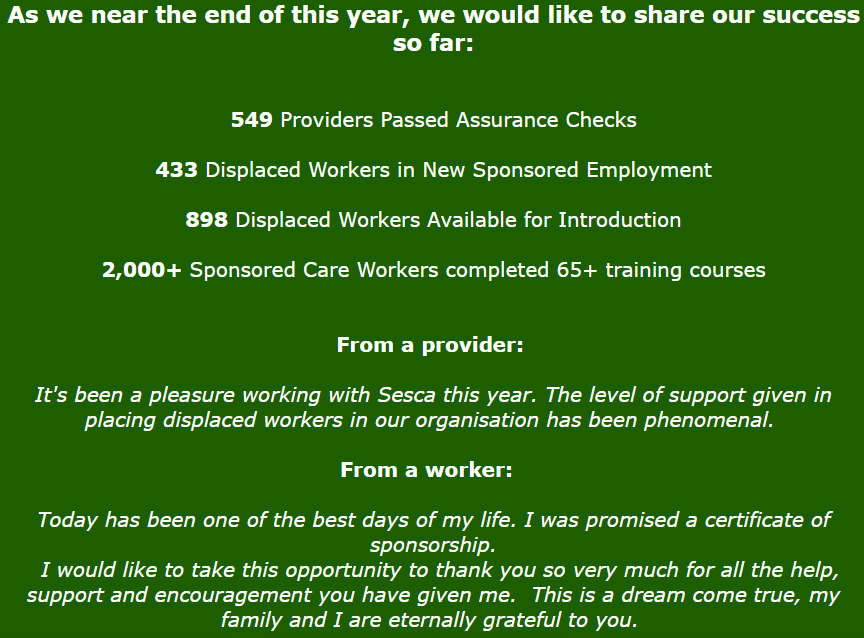
We thank the providers, workers and partners whose collaboration has made this possible — a strong example of integrated partnership working across the region.
|
|
|
|
Click here to view our new and updated website with all our Sponsors!
|
|
|
|
|
|
|
|
|
|
|
|
|
|
|
|
|
|
|
|
|
|
|